Custom business system cost in the Philippines cannot be estimated accurately from the number of screens alone. Two systems with similar-looking dashboards may require very different workflows, permissions, integrations, data work, and testing.
A useful quotation begins with scope and responsibility. This guide explains the factors a business should clarify before comparing proposals.
Workflow scope and exceptions
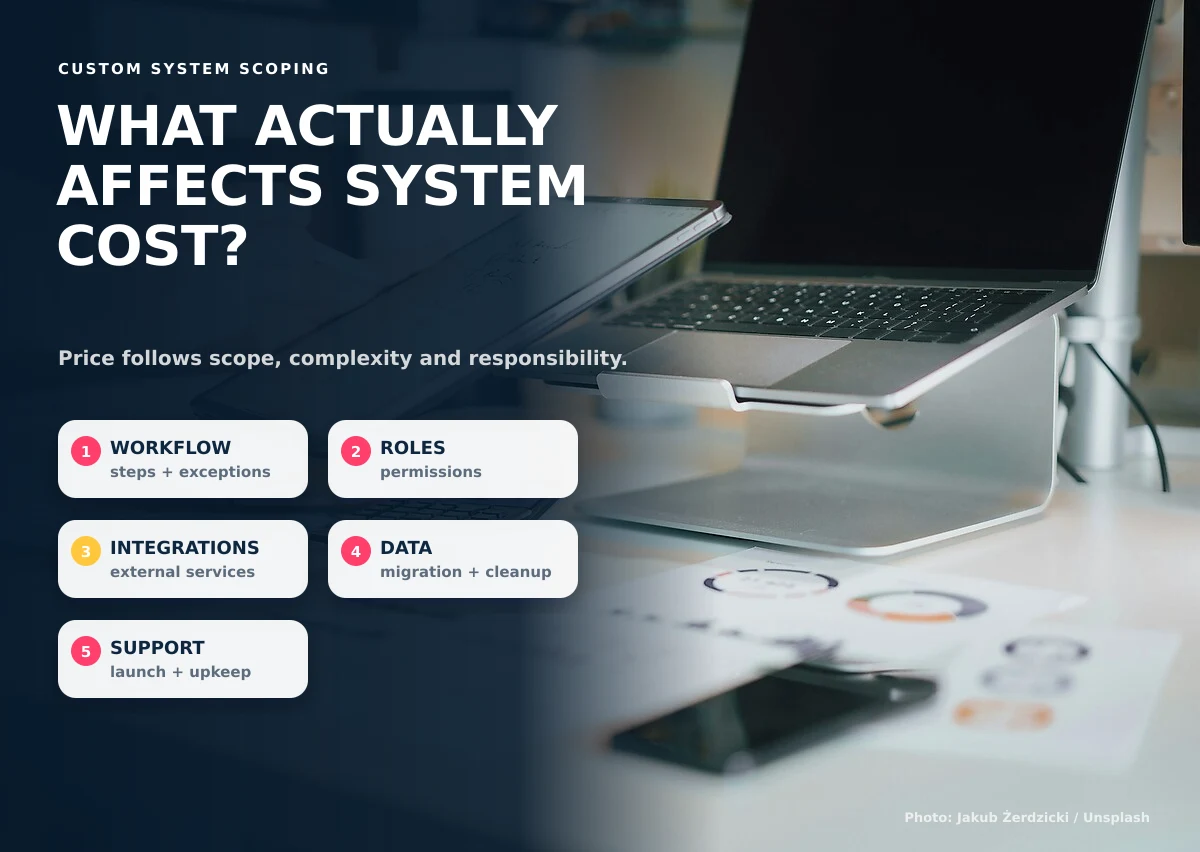
A simple request tracker may move through four predictable states. A larger operational system may include quotations, payments, documents, approvals, scheduling, fulfillment, returns, and several exception paths. Each rule needs design, implementation, and testing.
Number and complexity of user roles
Customer, staff, reviewer, manager, administrator, vendor, and branch roles may each require different records and actions. Record-level permissions add more planning than a system where every internal user sees the same information.
Customer portals and self-service
A public or customer-facing portal needs secure sign-in, account relationships, appropriate status information, forms, files, notifications, and responsive design. It should be scoped separately from an internal dashboard.
Integrations and external services
Payment providers, email delivery, SMS, maps, accounting tools, inventory sources, booking services, identity systems, and third-party APIs create dependencies. Availability, documentation, fees, limits, and testing environments affect the work.
Existing data and migration
Clean, consistent records are easier to import than years of duplicate spreadsheets with changing formats. Data mapping, cleanup rules, validation, migration testing, and rollback planning should appear in the scope when they are required.
Reports, exports, and audit history
A fixed summary is simpler than configurable reports with filters, permissions, exports, historical comparisons, and calculated indicators. Define the decisions each report supports before requesting a large report library.
Testing, training, launch, and support
Budget for realistic testing, user feedback, security review appropriate to the system, staff training, deployment, backups, monitoring, and post-launch support. A system is not finished merely because the screens have been coded.
How to request a useful quotation
| Provide | Why it helps |
|---|---|
| Current workflow | Reveals real steps and exceptions |
| Priority problem | Defines the first measurable goal |
| Users and roles | Clarifies interfaces and permissions |
| Required integrations | Identifies external dependencies |
| Sample records and reports | Makes data requirements concrete |
| Launch priority and constraints | Supports phased planning |
Ask whether each requested feature must exist in the first release. A phased plan can first connect intake, assignment, status, and essential reporting, then add customer self-service or integrations after the core workflow is stable. Phasing does not mean ignoring the future: the overall records and responsibilities should still be planned so the first release does not create a dead end.
Compare proposals by scope and assumptions, not only the total. Confirm which roles, workflows, integrations, migrated records, reports, training sessions, environments, warranty period, hosting services, and support arrangements are included. Identify recurring costs such as infrastructure, third-party services, maintenance, and messaging. Also ask how changes will be estimated and approved. A clear proposal should explain what will be delivered, how acceptance will be tested, and which responsibilities remain with the client.
Causing Designs scopes custom portals, dashboards, and workflow tools around a practical first release.
For a more useful discussion of custom business system cost in the Philippines, send us your current workflow and highest-priority problem.