To manage travel agency inquiries well, every request needs a clear path from the first message to the confirmed booking. Without that path, customer details remain scattered across Facebook, Messenger, email, spreadsheets, and personal notes.
A practical workflow helps consultants respond consistently, retain the customer’s requirements, prepare accurate quotations, follow up at the right time, and confirm that payments and documents are complete.
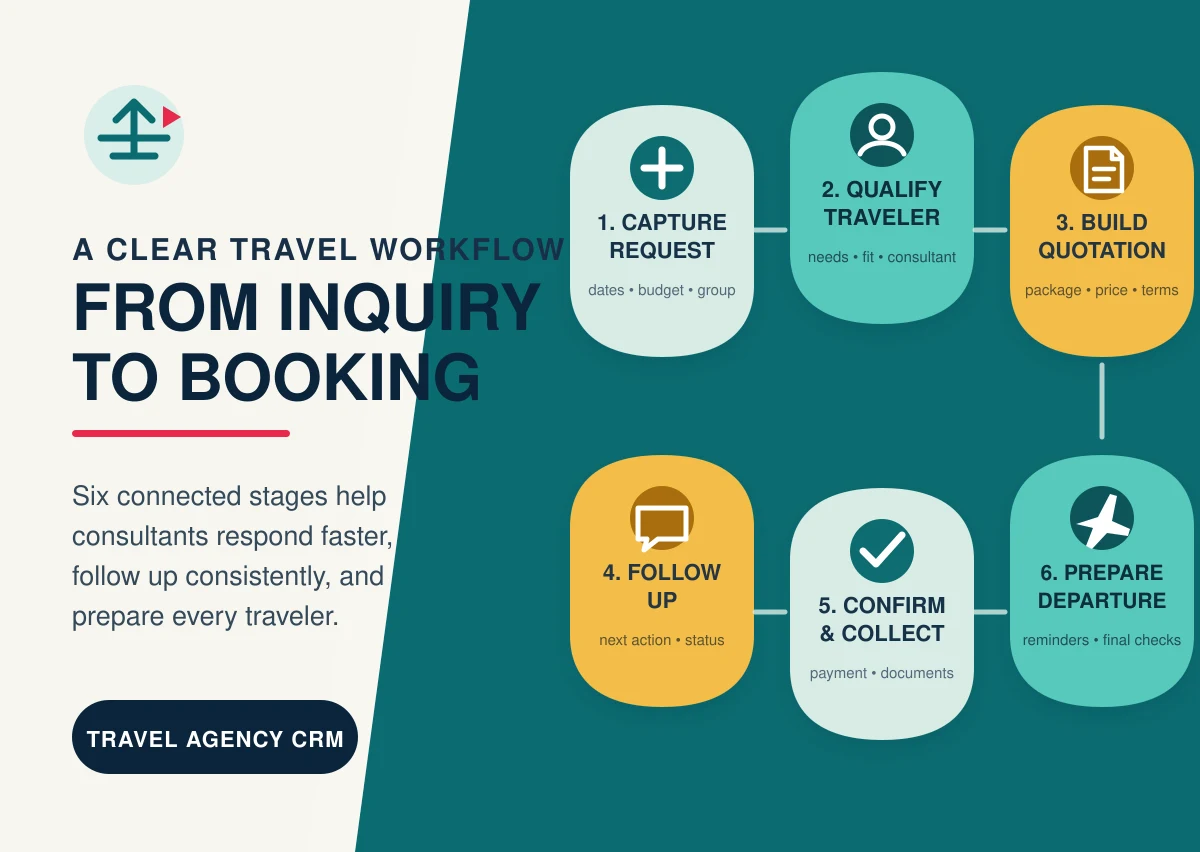
This guide presents a six-step travel agency inquiry workflow for Philippine agencies, independent consultants, and tour operators. It can be followed manually at first, then supported by a focused CRM when inquiry volume and team size increase.
What should a travel inquiry workflow accomplish?
A good workflow does more than store a customer’s name and phone number. It should help the agency answer five operational questions:
- What does the traveler need?
- Who is responsible for the inquiry?
- What has already been offered or discussed?
- What action should happen next?
- What is still missing before the booking is ready?
When those answers remain visible, another consultant or manager can understand the inquiry without searching through an entire message history.
1. Capture a structured travel request
Travel inquiries may arrive through a website form, Facebook page, Messenger conversation, email, phone call, referral, or walk-in visit. The source may change, but the essential information should enter one consistent record.
Capture the customer’s name, contact details, destination, proposed dates, number of travelers, age considerations, preferred departure airport, approximate budget, accommodation preference, and travel purpose. The agency may also ask whether the customer needs flights, hotels, tours, transfers, insurance, or visa assistance.
Do not make the first form unnecessarily long. Collect enough information to understand the request, then allow a consultant to clarify the details during qualification.
2. Qualify the traveler and assign a consultant
Not every message is ready for a complete quotation. Some customers are exploring destinations. Others have fixed dates, a realistic budget, and an immediate need.
A simple qualification stage helps the team decide what kind of response is appropriate. Confirm the customer’s priorities, flexibility, decision timeline, and important constraints. Then classify the inquiry using clear labels such as new, needs clarification, qualified, not currently suitable, or future follow-up.
Assign one consultant as the owner. Other team members may assist, but the customer should not receive conflicting questions or separate quotations from several people.
3. Build and record the quotation
A quotation should connect directly to the inquiry that produced it. Record the proposed package, inclusions, exclusions, dates, supplier assumptions, price, payment terms, validity period, and any items still subject to confirmation.
Customers often request changes. They may adjust travel dates, replace a hotel, add a traveler, or remove an activity. Keep each important quotation version so the consultant knows what changed and which option the customer is reviewing.
Travel requirements can change. Agencies should verify current passport, visa, and health information using authoritative sources for the destination. The IATA Travel Centre provides current international travel requirement information, but the responsible consultant should still confirm the sources appropriate to the booking.
4. Schedule and record the follow-up
A quotation is not the end of the sales process. It needs a next action. Record when the quotation was sent, the customer’s response, the consultant’s next follow-up date, and the current reason for waiting.
Useful follow-up statuses include quotation sent, customer reviewing, revision requested, awaiting companion decision, awaiting documents, awaiting payment, postponed, won, and lost.
Follow-up should remain helpful rather than repetitive. A consultant might clarify an option, explain a deadline, provide a revised quotation, or answer a specific concern. The record should show what value the next conversation needs to provide.
5. Confirm payment, booking details, and documents
Once the customer accepts an offer, move the inquiry into a defined booking stage. Record the selected package, traveler names, agreed price, deposit or payment schedule, payment reference, supplier confirmations, and remaining balance.
Payment reported and payment verified should be separate statuses. A customer may upload a receipt or provide a reference, while an authorized staff member confirms that the funds were received.
Document tracking also needs clear states. Instead of a single “documents” note, identify which items are required, received, reviewed, incomplete, expired, or still missing.
Travel agencies handle personal information and may receive identity or travel documents. The National Privacy Commission has specifically called for data privacy compliance in the travel and tourism sector. Access, storage, retention, and sharing should therefore be planned carefully rather than treated as ordinary file storage.
6. Prepare departure and continue customer care
A confirmed booking still requires operational preparation. Track final supplier confirmations, vouchers, tickets, insurance information, transfer instructions, required documents, final payment, customer reminders, and departure readiness.
Use a checklist that shows both the required item and the person responsible. This reduces the risk of assuming that someone else completed an important task.
After the trip, record relevant feedback, unresolved concerns, destination interests, and appropriate follow-up opportunities. A complete customer history can improve repeat service without forcing the traveler to explain every preference again.
A practical status pipeline
| Stage | Main owner | Required output |
|---|---|---|
| New inquiry | Inquiry desk or assigned consultant | Structured customer request |
| Qualification | Consultant | Confirmed needs and next action |
| Quotation | Consultant or package specialist | Recorded proposal and version |
| Follow-up | Assigned consultant | Response, status, and follow-up date |
| Confirmation | Consultant and authorized payment reviewer | Selected package, verified payment state, and required documents |
| Departure readiness | Operations team | Completed checklist and customer instructions |
The exact labels should match the agency’s process. However, each status should describe a real business condition rather than a vague label such as “ongoing.”
Common signs that the inquiry process is breaking
- Several consultants respond to the same customer without coordination.
- Customer requirements are copied repeatedly from messages into documents and spreadsheets.
- The latest quotation cannot be identified quickly.
- Follow-ups depend on personal reminders or memory.
- Managers cannot see how many inquiries are waiting for action.
- Payment proofs, passport copies, and booking details are scattered across devices or chat threads.
- Operations staff receive incomplete information after the sale.
If several of these problems happen every week, a shared spreadsheet may no longer be enough to manage travel agency inquiries reliably.
What should be automated—and what should remain human?
Automation works best for predictable tasks. A system can collect structured preferences, assign an inquiry, schedule reminders, show missing fields, update a status, and prepare standard notifications.
AI assistance may help summarize a request, organize approved package information, or prepare a draft response. However, a qualified person should confirm pricing, availability, suitability, travel requirements, documents, and commitments made to the customer.
The goal is not to remove the consultant. It is to give the consultant a complete record and reduce avoidable administrative work.
How to start improving the workflow
- List every channel where inquiries currently arrive.
- Define the minimum information needed before preparing a quotation.
- Agree on clear inquiry, quotation, payment, document, and booking statuses.
- Assign one responsible owner and one next action to every active inquiry.
- Identify which reports managers actually need each week or month.
- Build the smallest useful system around the highest-volume problems first.
Causing Designs builds a travel agency CRM and guided inquiry experience that can connect customer preferences, consultant assignments, quotations, bookings, payment states, documents, reminders, and activity history.
If your agency wants a clearer way to manage travel agency inquiries, show us how your team handles them today. We can map the current workflow and recommend a practical first version.